Review
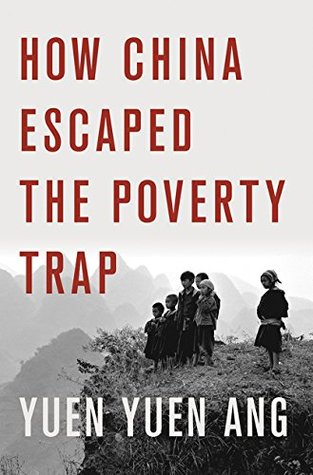
To put it in simple (and sexy) terms, economic development is, at its core, a path to self-determination, a life well-lived, and the ability to give labor (and existence) meaning –– this is why I love development studies so much. Professor Ang is truly a thought leader in this field. (I’ve been star-struck since I first attended her seminar in January 2020!) This is a masterpiece that illustrates complexity theory in practice. Indisputably, no modern development case gets as complex as that of China in a mere 35 years. As the world benefits from the stability and prosperity of this country that is so deeply embedded into the global network, the world will also suffer from the growing pains and heavy costs of China’s accelerated development in the past decades.
Built upon the works of countless renowned modern economists, sociologists, and political scientists, this book further revolutionizes how we understand the adaptivity of complex systems that are capable of delivering developmental outcomes. Seeing through the fog of often over-simplified notions such as “good governance —> growth,” Dr. Ang invites us to examine economic development as a coevolutionary process that looks more like an improvised dance to bridge highly localized conditions (often shortcomings) and ambitions. It all goes back to our attempt to answer a simple yet perplexing conundrum: indeed, human flourishing is our shared dream, yet without good institutions, how can one go about preserving conditions for growth that one currently does not have and cannot afford?
Six key takeaways Dr. Ang highlights:
1. Delimit boundaries of experimentation and flexibility
2. Activate incremental changes across connected domains simultaneously
3. In the beginning, define success narrowly (to account for geographical and endowment differences)
4. Give everyone a personal stake in the development process (decentralize the system!)
5. Let some get rich first but pair up the poor and the rich (“the flying geese,” regional variations are as salient as their connections)
6. Harness weak institutions to build markets, or more simply, “use what you have”
This book is simply too breathtaking!! Lots to soak in… lots of notes to organize.
A super insightful book for anyone who's interested in poverty alleviation, human development, economics fieldwork, how to do good social science research, etc. etc.
Built upon the works of countless renowned modern economists, sociologists, and political scientists, this book further revolutionizes how we understand the adaptivity of complex systems that are capable of delivering developmental outcomes. Seeing through the fog of often over-simplified notions such as “good governance —> growth,” Dr. Ang invites us to examine economic development as a coevolutionary process that looks more like an improvised dance to bridge highly localized conditions (often shortcomings) and ambitions. It all goes back to our attempt to answer a simple yet perplexing conundrum: indeed, human flourishing is our shared dream, yet without good institutions, how can one go about preserving conditions for growth that one currently does not have and cannot afford?
Six key takeaways Dr. Ang highlights:
1. Delimit boundaries of experimentation and flexibility
2. Activate incremental changes across connected domains simultaneously
3. In the beginning, define success narrowly (to account for geographical and endowment differences)
4. Give everyone a personal stake in the development process (decentralize the system!)
5. Let some get rich first but pair up the poor and the rich (“the flying geese,” regional variations are as salient as their connections)
6. Harness weak institutions to build markets, or more simply, “use what you have”
This book is simply too breathtaking!! Lots to soak in… lots of notes to organize.
A super insightful book for anyone who's interested in poverty alleviation, human development, economics fieldwork, how to do good social science research, etc. etc.